


GEGS
- Dec 28, 2018
- 5 min read
No, I have not lost my mind (yet). GEGS is scrambled eggs! Get it? Everyone has had scrambled eggs. But have you really had scrambled eggs? This here is a true classic and one of my all-time favourites to make. In fact, it is becoming a Christmas morning tradition! About 10 minutes to make and less than a dollar. Tips plating in this post too!

Ingredients
1) 3 eggs per portion
2) Butter
3) Salt and pepper
4) Creme fraiche
As always, this recipe is a guide not to be followed to the t. Why? Well for example, the cooking time will vary depending on the size of your saucepan, size of the eggs, electric hob or gas stove (a gas stove heating your pan up quicker and thus a shorter cook time). The purpose of my blog, or at least my hope, is to focus more on the techniques that you can learn. This way you begin to learn how to cook instead of copying.
Method
1) Crack the eggs into a cold saucepan. Add about three small knobs of butter to the pan too.
Tip: Cold because you don't want to scorch your eggs but instead want the texture to be creamy. To achieve that, you don't want your egg to fry which is what will happen if you crack it in a hot pan.
2) Use a spatula to break the yolks and start stirring the eggs over a medium to medium high heat, bringing the pan up to temperature. Keep stirring and do not stop.
(You can actually put the heat on high and it will cook much faster. BUT. I advise you put it on medium-medium high the first few times you make scrambled eggs to better control the cook and avoid accidental overcooking.)
On a medium to medium high gas stove, it will take approximately a minute or two for the eggs to begin curdling (About 30 seconds if you are on a high heat probably). At which time, stir the eggs for about 15 seconds on the heat. Then take the saucepan off the heat, onto the counter, and stir for about 15 seconds. (Or for 5+ seconds each if on a high heat)
3) Keep stirring the eggs for about 15 seconds on and 15 seconds off the heat on repeat until the eggs begin to thicken and small curdles form. Scrape the bottom and sides of your pan often to prevent large curds from forming. You want the eggs to reach a consistency somewhere between heavy cream and a good thick greek yogurt. (A weird way of describing eggs I know but the point is, you do not want to see or feel large individual curds. The scrambled eggs I grew up on, or at least that are served in typical breakfast buffets are solid with large egg curds and can even be eaten with chopsticks. Nostalgic as that might be, scrambled eggs done right should be creamy and luxurious.)
4) When your eggs have thickened up but still just a little under, after about 5 mins of cooking, take them off the heat. The residual heat in the pan will keep cooking the eggs. (This is true when you are cooking anything really. Meat, pasta etc. You cook it just a little under because it continues cooking with the residual heat)
At this point, add a spoon of creme fraiche (or heavy cream if you can't find any). This helps to drop the temperature of the eggs thus stopping it from overcooking while making it creamier. Season with salt and pepper now. Take a small taste of the eggs to see if you need to adjust the seasoning in any way. More butter, salt, or pepper for example? Or is the seasoning spot on. But here you have it! Creamy scrambled eggs.
How to pimp it up? Have it with toasted bread/baguette/sourdough slices. This gives a nice crunch against the silky scrambled eggs. Grill some tomatoes and/or mushrooms with a drizzle of balsamic/red wine vinegar. The acidity of the vinegar, sweetness from the tomatoes, and earthiness of the mushrooms compliment the slight richness of the eggs. You can also add some chopped chives or picked thyme flowers into the eggs!

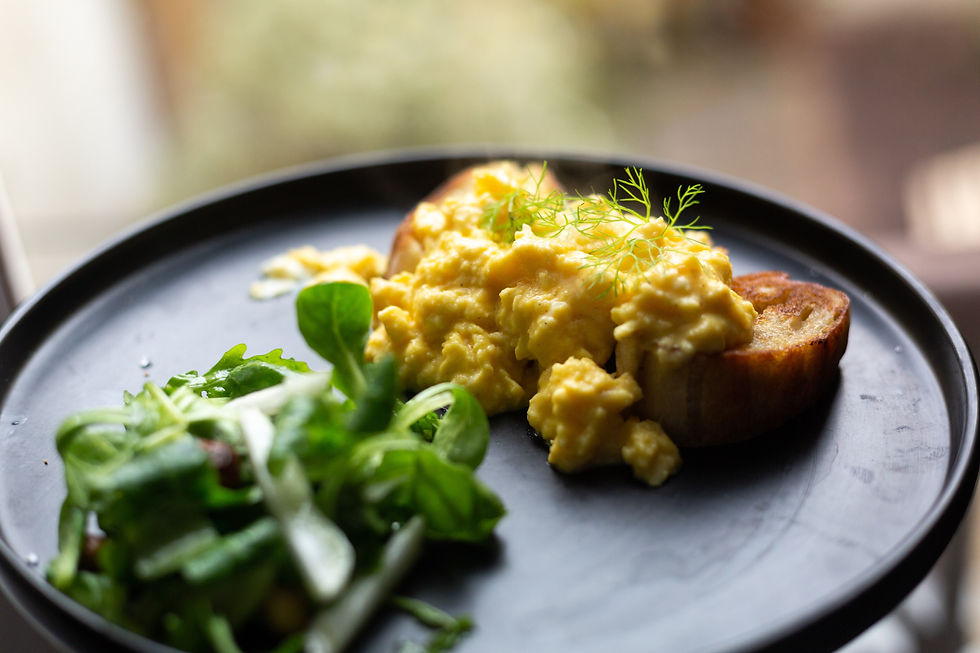
This one above is on a brioche toast with chorizo shards, chèvre flakes, finished with carrot tops (the leafy part of the carrots that tastes almost like parsley). The one below is served on baguette with a watercress and arugula salad.
And so now for some general tips!
First on plating. We first eat with our nose and our eyes. And so looks and smells are important. Before I cook, I first imagine how I want it to taste, smell, and look. For the looks, I sketch a simple mental picture out on a paper. I think of what elements I want in a dish, how they would complement each other, and how I would plate it so it looks good but is functional. For example, for the eggplant dish I knew I wanted some crunch and sweetness (thus I chose pomegranates) but also something to balance and mellow the flavours (chèvre). I then drew where on the plate I want the eggplant to be. The different versions reflected that (center/off-center etc.), but also had the pomegranate and goats curd scattered on different parts of the plate (e.g. around the eggplant). You can see the final version that I settled on in my last blog post. It usually takes about 3-ish sketches before I reach a design that I like. The reality is even then, when I do get around to plating, it does not always materialise the way I envision it to. And so I try again.
There are 2 general ways to plate stuff. The first is asymmetrically. You put the main ingredient (e.g. the protein) off center. You then build the garnishes (vegetables etc.) around it. The first and last egg pictures above are two such example. Baguette slices are laid on the side, egg spooned over it, and vine tomatoes draped to extend to the other side of the plate. The other is to build from the center of the plate out. That is the second egg picture where the dish is dead middle. Whichever strategy you adopt, the key is to leave a good amount of negative space, aka empty plate space. Having the plate less cluttered allows your actual ingredients to stand out more. Not to mention we don't really need to eat a plate piled high with food. Aesthetically pleasing but also better for your body and the planet.
Point being, play around with it. Experiment. Be willing to fail. And then try again. The same goes with actually trying the recipes. Use the recipes as a guide not gospel truth. How long you cook the ingredient for, at what heat, how much seasoning always varies because the piece of ingredient you use will invariably be different in size from the one you get. If anything, I hope you pick up little techniques and tips and a willingness to try instead of specific timings! In this case, if you overcook your scrambled eggs the first time, you are in good company. I have countless times. Try, and try again, and never give up.
Comments